
- Details
Meeting
Summit meeting of the SFB-TR 87
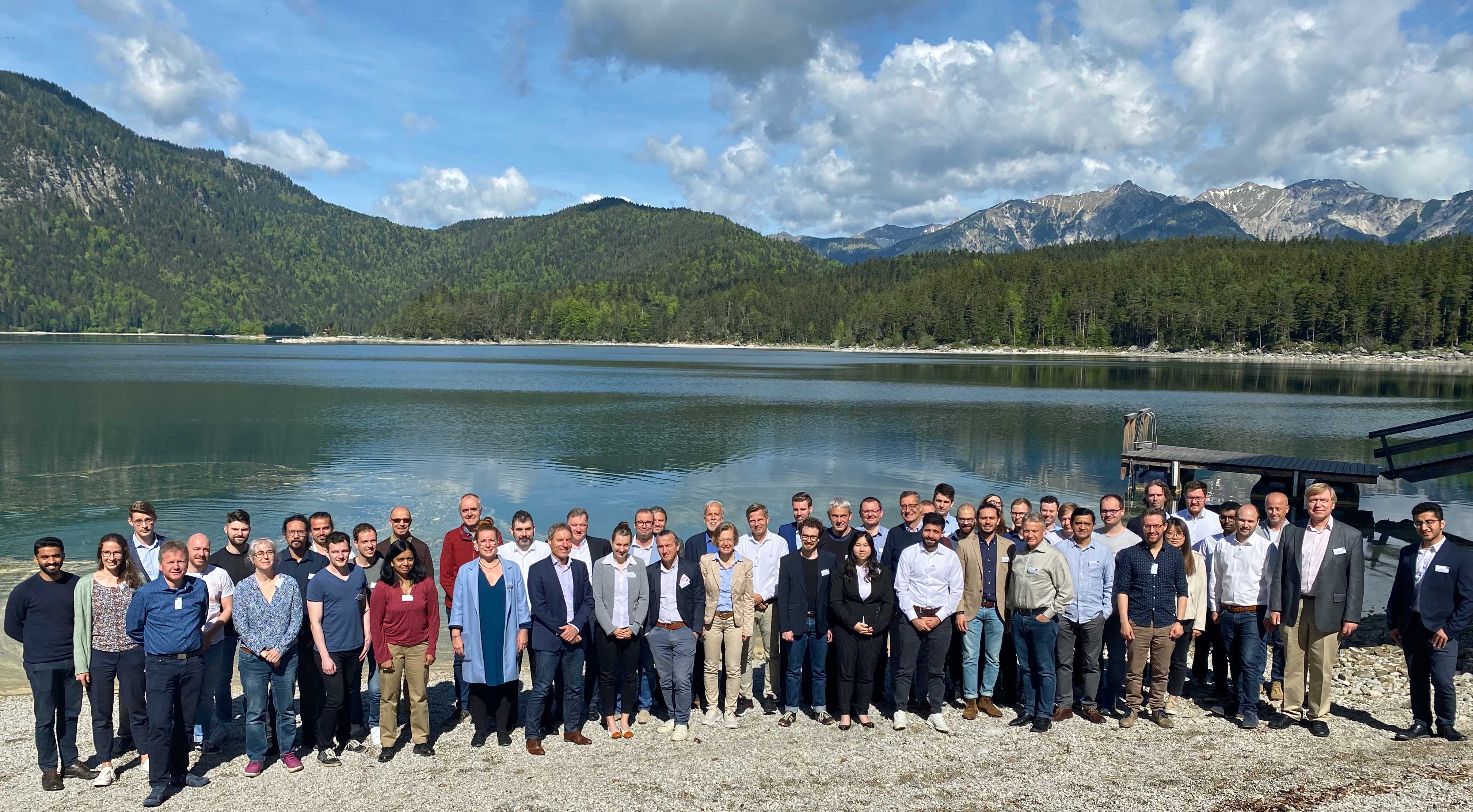
In order to bring the findings of the last twelve years to a round conclusion, a summit meeting was organized by Peter Awakowicz, the spokesperson of the SFB- TR 87. This took place from May 15 to May 18 in the conference center at the Eibsee. Moreover, the Mercator Fellows, Prof. Dr Ludvik Martinu, Prof. Dr Christian Mitterer, as well as the guests, Prof. Dr André Anders and Hon.-Prof. Dr. Christian Oehr were included in the program. Their lectures were the highlights of the lecture series.
Furthermore, the most important results of the individual research areas were presented in lectures. In addition, junior researchers were asked to give comprehensive presentations in groups. The fruitful discussion within the research-oriented sessions, as well as over a cup of coffee, was a great success of this event.
In the end, the presentation on new research questions by Peter Awakowicz could motivate future research fields very nicely. Peter Awakowicz is credited for his communicative way of bringing together different researchers over twelve years and leading them to high-class results. In addition, many young researchers have been trained during this time and have been very well supported in the consortium.
- Details
Exchange Research Data Management UA Ruhr & Oulu
Under the slogan "Mining of research data instead of coal" the UA Ruhr organized an international knowledge exchange on data management with researchers working as data stewards at the University of Oulu, Finland on 11th and 12th May. The event was host- ed in the convention center of Ruhr University Bochum and by zoom.
The local structures supporting research data management at the UA Ruhr universities were presented and experiences on advice, training and data management plans, and discuss best practices were shared.
Furthermore, an exchange between the CRCs CRC 1280 and CRC 1316 as well as the partners from UA-Ruhr and the Finnish guests took place. Here researchers and da- ta stewards as well as data experts from the consortia were brought together.
The event was a great success, as the structures on both sides differ, but the challenges of the individual actors in the field of data management are identical. Thus, many interesting experiences could be exchanged. Due to the success, a return visit to Oulu is now being planned to continue the exchange.
- Details
PROCOPE
French guests at PIP
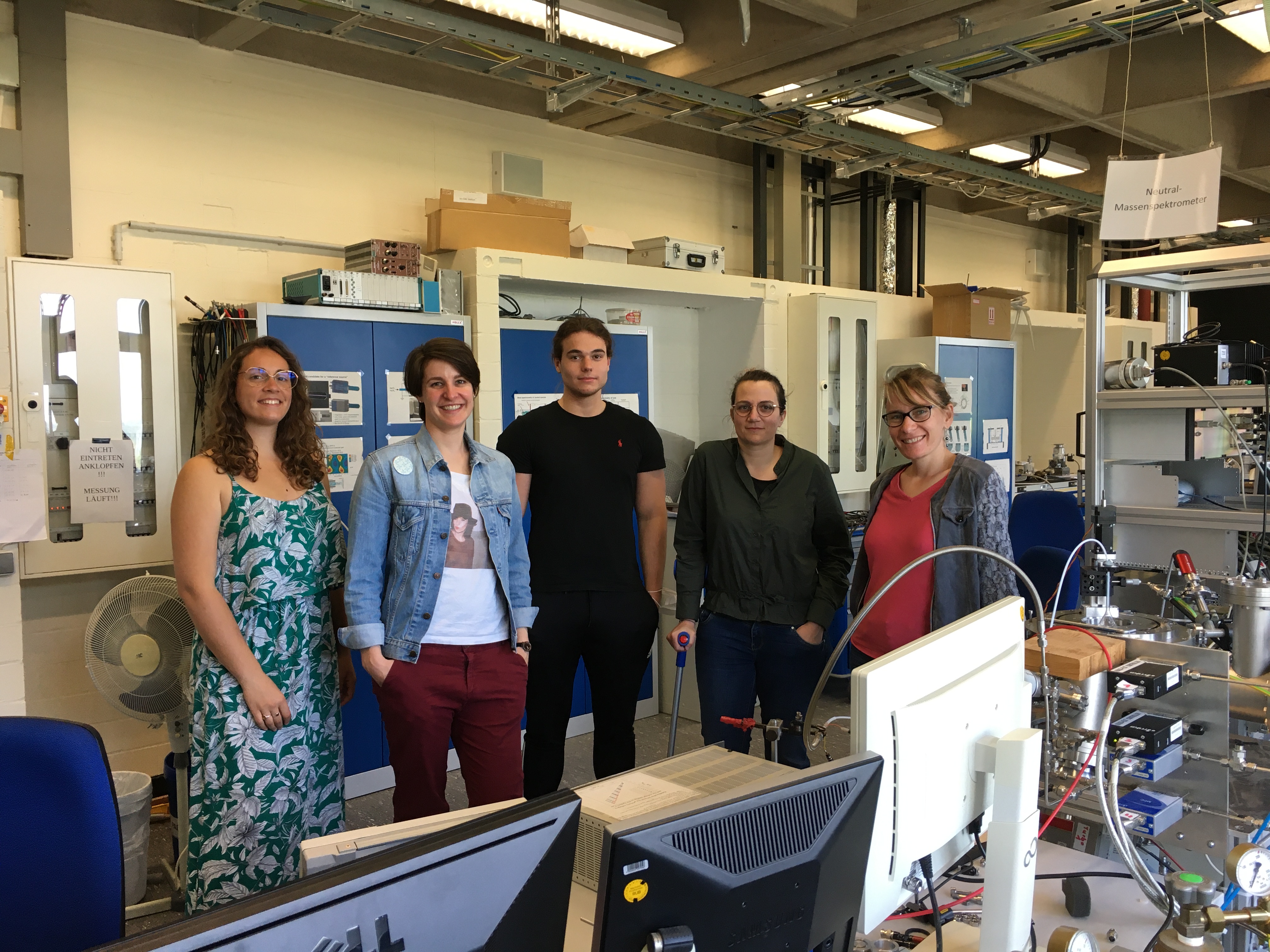 Within the frame of the PROCOPE project, Claire Douat and Eloise Mestre from GREMI in Orléans, France, visit the Bochum lab of Jun.-Prof. Judith Golda. The research stay takes place between May 8 until May 22 to study the effect of plasma-produced CO on cells.
PROCOPE is a DAAD funded project to enhance the cooperation between RUB and GREMI.
- Details
Girl's day 2022
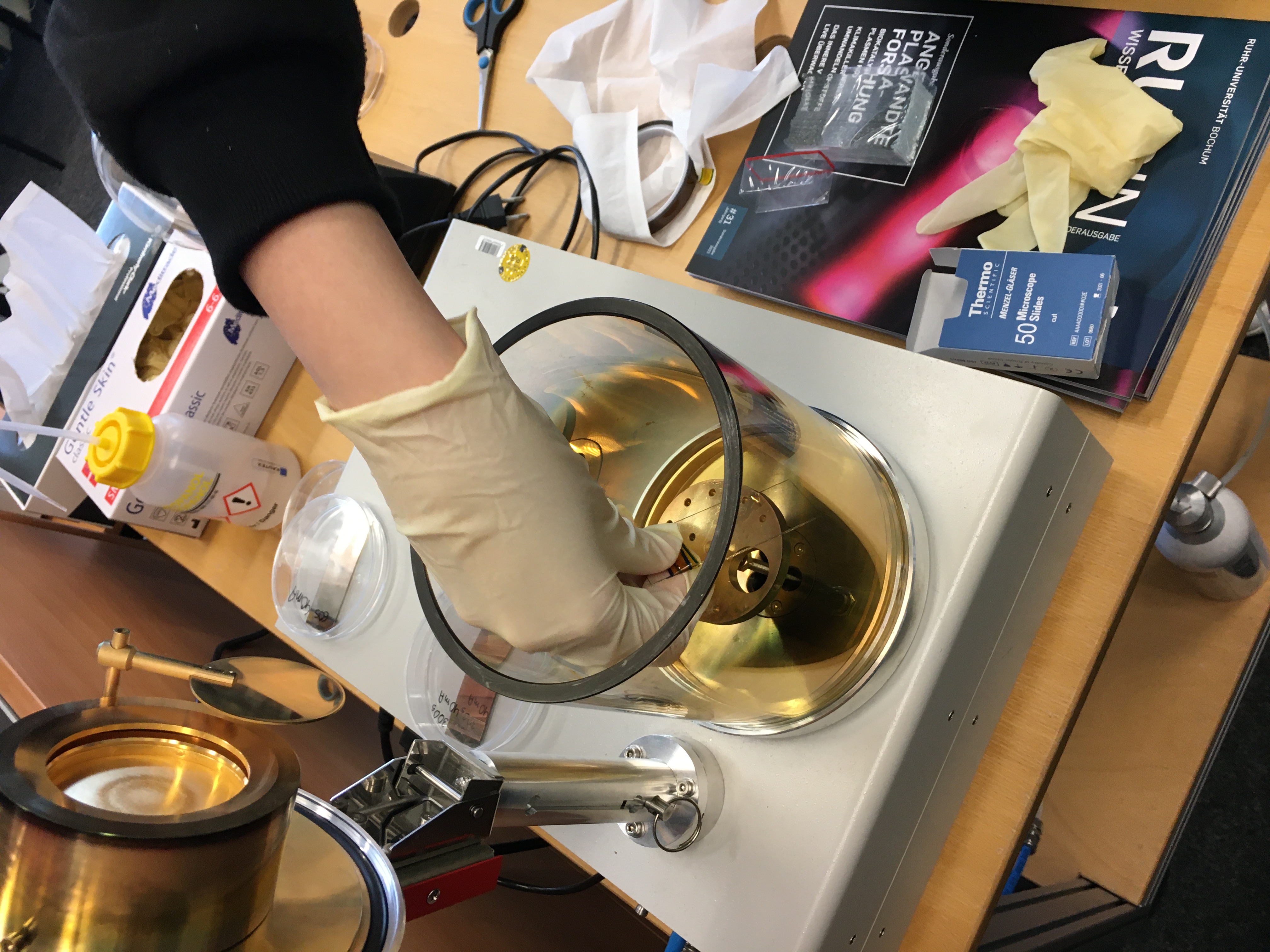
On April 28th, the annual Girls’ Day took place. Offering a 5-hour hands-on workshop on plasma physics, female students could dive into university physics as well as learn more about science, studying and career options pursuing studies in physics. During the workshop, the school students first got to know the basics of plasma – what does it consist of, how can we influence its behav- iour and which characteristics does it have. Following this rather theoretical part, the school students worked on the sputter coater, making samples to analyse with a
profilometer and identify the thickness of the surface coating from the sputtering process. The aim of the Girls’ Day is to offer female school students an insight into technical and scientific careers and motivate more school students to choose a degree in a MINT-subject. We also aim at reducing prejudices and fears towards a physics degree.
- Details
Project Week during Easter Break
During the first week of the Easter break, the project weeks for female high school students (in German Schülerinnenprojektwoche) took place and opened the doors towards plasma physics, astronomy and physics in medicine for school students grade 8 to 10.
Hosting three projects, the offer is continuously expanding after the Corona lockdown. During the project week, students attended a lecture given by PD Dr. Horst Ficht- ner on ‘news from the edge of the solar system’, visited the Planetarium in Bochum and worked on scientific projects during their workshops. The outcomes of the research projects were presented in a poster session followed by a quiz and shared lunch, which formed the conclusion of the week.
To lower the entry barrier of the project week and offer school students the chance to participate no matter of their financial status, some changes were implemented as a trial. School students who do not own a ticket for public transport had the option to receive a ticket for transportation to and from university. Also, meals were newly included in the project week. While only break- fast used to be supplied, students could now share a
free lunch in the campus dining hall, enhancing the group dynamics and their feeling of belonging in the group.
The feedback to this changes were positive according to the feedback of the participants, so that the changes will be continuously adapted to the program of the pro- ject week The project week in autumn will presumably take place with four projects at full capacity.
- Details
FOR 5409 "Structure-preserving numerical methods for volume and transition coupling of heterogeneous models" approved
The DFG has approved nine research groups for funding. To one of those, the FOR 5409, PIs Prof. Grauer and Dr. Dreher of the Research Department plasmas with complex interactions contribute.
The research group "Structure-preserving numerical methods for volume and transition coupling of heterogeneous models" conducts research on the modeling and simulation of coupled systems to describe magnetized plasmas, complex fluids, and electrochemical processes. In coupled systems, multiple processes are considered in the same region of a selected physical domain (volume coupling) or mathematical models used in different parts of a domain are combined at common boundaries (transition coupling). The goal is to develop efficient numerical methods that guarantee important structural properties of the underlying continuous models and to implement them on high-performance computers.
The chair TP I from RUB is involved with three (of nine) projects:
Project A2 (Rainer Grauer, RUB): Coupling the two-fluid/Maxwell system to Magnetohydrodynamics/Ohm's law
Project A3 (Jürgen Dreher, RUB): Adaptivity in Computational Cardiac Electrophysiology
Project B2 (Rainer Grauer, RUB and Christiane Helzel, HHU): An Active Flux Method for the Vlasov/Maxwell System
Congratulations to the PIs for this success!
- Details
CRC 1316 MGK Colloquium
With the start of the second funding period, all PhD students of the projects within the CRC 1316 were invited to participate in the annually MGK colloquium. The colloquium was held online at 7th and 8th of March 2022 and was organized by Maximilian Klich (project A8) and David Schulenberg (project A4).
The colloquium served as an introduction of the many new PhDs joining the CRC 1316 in its second funding period. Without the participation of project leaders it achieved a casual atmosphere for sharing scientific knowledge and interests between the PhD students. Here, they could introduce themselves and their pro- jects as well as give a short summary about their pro- jects achievements and future plans through talks or a poster presentation. Leading the talks regarding the different research topics modelling, DBD/RF discharg- es and plasma in liquids were the invited speakers which generated a well rounded experience.
The new funding period also required a few elections, namely the position of the PhD speaker formerly held by Maximilian Klich, as well as a position in the CRC 1316 gender board held by Lars Schücke (project A7) and Katharina Grosse (project B7). The newly elect- ed PhD speaker is David Schulenberg and Stefanie Bo- genrieder (project B4) as well as Lukas Forschner (project B12) are the new gender board representative.
- Details
Achim von Keudell new Editor in Chief for Plasma Processes and Polymers
Achim von Keudell became with the beginning of March one of the four Editors in Chief of Plasma Processes and Polymers.
- Details
DFG approves second funding period of the CRC 1316
Plasmas for the Systems for material conversion are an important component in the utilization and storage of decentrally generated renewable energies. The Collaborative Research Center 1316 (CRC 1316) "Transient Atmospheric Pressure Plasmas - from Plasma to Liquids to Solids" is dedicated to combining atmospheric pressure plasmas with catalysis to develop the most flexible solutions possible for this material conversion. "They should be scalable, controllable and robust against external influences, such as impurities in the starting materials," explains Prof. Dr. Achim von Keudell, spokesman of the CRC.
The first funding period of the CRC 1316 was dedicated to the elucidation of transient phenomena in atmospheric pressure plasmas as well as interfacial processes at the surface of catalysts. Here, the focus was on three systems: the plasma-catalytic conversion of gases, the combination of plasmas with electrolysis at the interface between liquid and solid, and plasma-assisted biocatalysis, in which enzymes very selectively produce new molecules. The researchers were able to make great progress in these areas: For example, they achieved precise control of the formation of reactive particles in these plasmas. They were also able to gain a deeper understanding of the atomic and molecular surface processes in these systems.
In the second funding period, these findings will be brought together to make the best possible use of the interplay between a plasma with its reactive particles and a catalytically active surface. There are many further questions in this regard, since in traditional catalysis, for example, stable molecules are essentially reaction partners, whereas in plasma catalysis, reactive particles or highly excited species can accelerate or suppress a specific reaction path. On this basis, the first prototype plants for plasma catalysis, plasma electrolysis and plasma biocatalysis are to be developed.
In addition to the RUB as the host university, researchers from the University of Ulm, the Jülich Research Center and the Fritz Haber Institute in Berlin are involved in the CRC.
- Details
General assembly 2021
All members of the RDPCI are cordially invited to attend this year's full meeting of the Reserch Department Plasmas with Complex Interactions. It will be held on Dec. 15, 2021 at 1 p.m. via zoom.
- Details
Approval for Jun.-Prof. Golda's DAAD project
In collaboration with Dr. Claire Douat from the institute GREMI in Orléans, France, Jun.-Prof. Judith Golda has submitted a DAAD project on the diagnostics and application of plasma radiation as a CO source for sterilization in wound healing. This has now been approved by the DAAD for 1.1.2022.
The aim of the project is to investigate the production pathways and the role of the CO molecule in the plasma treatment of biological material. To study CO generation in CAPs, two well-characterized plasma sources will be used that have complementary operating principles: A radial kHz-dielectric barrier discharge with direct contact of the plasma including ions, electrons, and strong electric fields with the treated substrate; and a coplanar RF discharge where only the field-free plasma effluent containing reactive species and plasma-generated photons reaches the substrate. This project will explore possible synergistic effects between CO and plasma-generated species such as electric fields, ions and electrons, photons, and other neutral radicals. The two complementary plasma sources will be used to distinguish the effects of indirect and direct plasma treatment on the impact of plasma-produced CO on bacteria. The plasma sources used here will be characterized with CO2 admixture to ensure that the amount of CO produced is below the toxicity limit. Parameter variations will be used to determine the optimal CO production conditions.
The project includes travel expenses to address the planned research questions.
Link to the group: https://piplab.rub.de