
- Details
INTERNATIONAL WORKSHOP "COSMIC RAY ANISOTROPIES"
This interdisciplinary workshop will give a synoptic overview of the cosmic ray anisotropy observations by the large area telescopes as IceCube, Milagro, the Tibet airshower array among others, and those observed by spacecraft especially by the Voyager and Pamela spacecraft and the AMS instrument, as well as the theory and modeling efforts including that of the large scale heliosphere. The anisotropies in the cosmic ray flux appear from the high energy range (TeV) to low energy range (keV to MeV) that is in the propagation of galactic cosmic rays to the propagation of solar energetic particles as well as that of Jovian electrons. Recent Voyager observations also suggest that the low energy flux at the heliopause is anisotropic.
To describe the anisotropic transport a couple of models are discussed in literature. In the inner heliosphere focussed transport theories are used, which are solved numerically with the help of the equivalent stochastic differential equations. In the heliotail, for the high energy, the gyroradius is of the order of the cylindric diameter of the tail and thus one has to use the full orbit theory.
In addition all the transport models need as input the state of the local plasma enviroment. The latter is provided by large scale magnetohydrodynamic models.
Finallly, the transport of cosmic rays depends on the diffusion tensor, which is affected by the local magnetic field fluctuations and its turbulence. The acceleration or deceleration depends on the local structure of the shock fronts.
The positron anisotropy observed by Pamela spacecraft and the AMS instrument onboard of the ISS are another aspect of anomalies in the cosmic ray spectra, and some aspects shall be discussed with the emphasis on anisotropic distribution functions.
The workshop takes place at Physikzentrum Bad Honnef, 26 - 30 Januar 2015.
link to Workshop Website
- Details
EP5
PROF. DR. SATOSHI HAMAGUCHI
Prof. Dr. Satoshi Hamaguchi will be a guest of Prof. Dr. Uwe Czarnetzki (Experimental Physics V) on January 27/28, 2015.
- Details
EP2
SHAOJUN XU
PhD student Shaojun Xu from University of Manchester is staying at Experimental Physics II (RUB) from January 26th-30th, 2015. He is working for the Marie Curie - Initial Training Network Reactive Atmospheric Plasma processIng (RAPID).
Working with Simon Hübner, Gert Willems, Simon Große-Kreul and other students and staffs in our group, Shaojun was here to carry out the mass spectroscopic study of UV-catalysis system, which was to study the UV photocatalysis effect for ions generation in different air humidity with and without TiO2. The ions Mass Specs and neutral Mass Specs are employed for measurement. The results was expected to show the synergistic effect between UV and TiO2 catalyst. The effect of air humidity was also discovered.
- Details
PROF. JAN BENEDIKT AT SAPP CONFERENCE
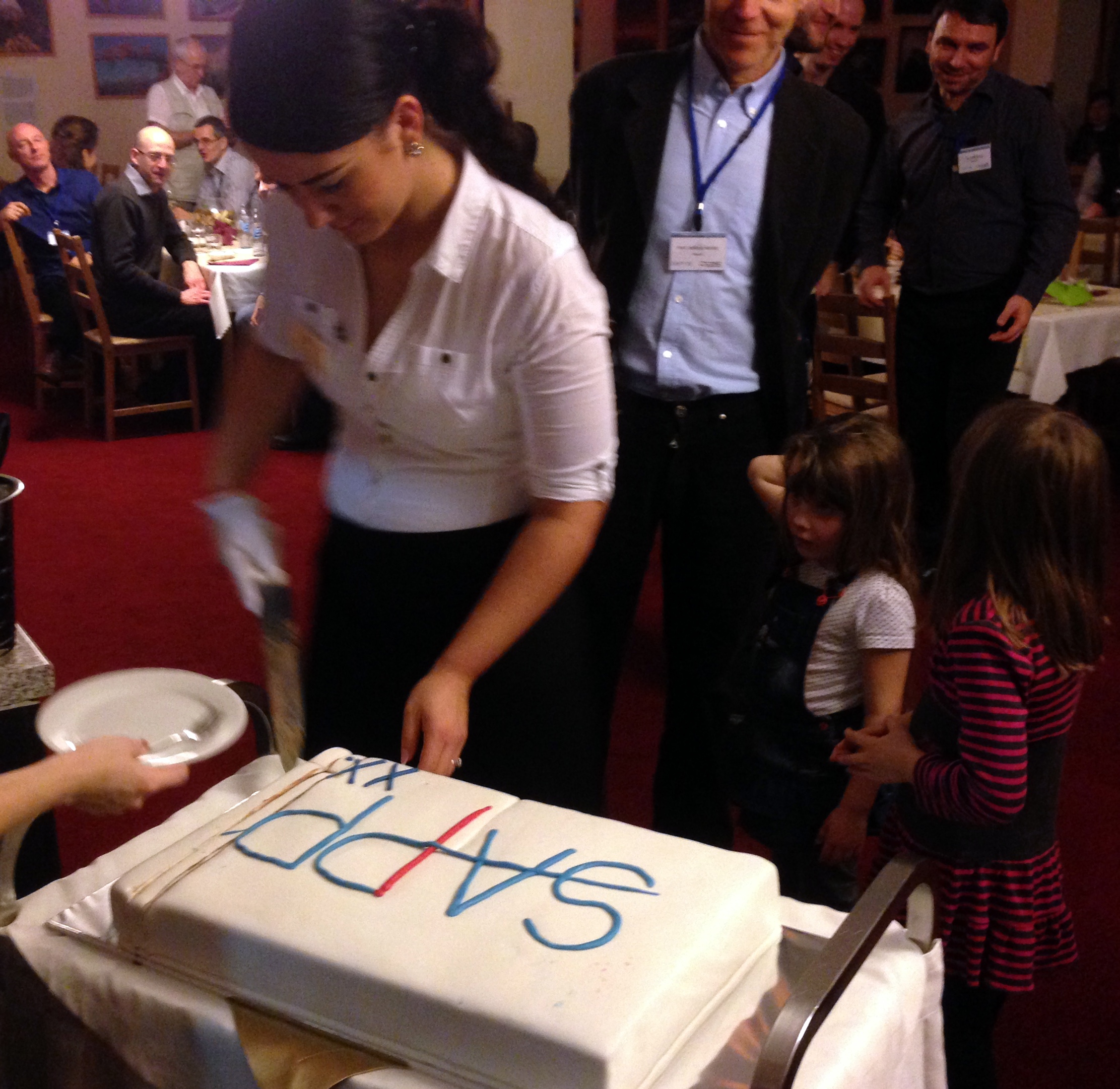
Jun.-Prof. Dr. Jan Benedikt has an invited talk “Study of plasma-chemistry processes in atmospheric plasmas: Absolute density measurements of radicals, VUV spectroscopy and some simulations” at the SAPP XX conference. This is the 20th Symposium on Applications of Plasma Processes (SAPP XX), which was this year combined with the COST TD1208 Workshop on Application of Gaseous Plasmas with Liquids. The symposium is held every two years in Slovakia and was located at Hotel SLOVAN in Taranská Lomnica, Vysoké Tatry between January 17 and January 22, 2015.
link to Conference Website
- Details
TP4
DR. HONQING HE
Dr. Honqing He from the Chinese Academy of Science, Beijing, China has been staying at the Institute of Theoretical Physics IV / Chair of Space and Astrophysics (Prof. Dr. Reinhard Schlickeiser) for two years since May 2014. His stay is supported for one year by a grant from the "China Postdoctoral Science Foundation Program", the second year by the chair.
- Details
EP5
PhD Emile Carbone AvH scholarship
Postdoc Dr. Emile Carbone will stay with a AvH scholarship at the Chair for Plasma and Atomic Physics (Experimentalphysics V) with Prof. Dr. Uwe Czarnetzki for two years. He is Belgian and used to work for as a postdoc for CNRS at Laboratoire des Technologies de la Microélectronique in Grenoble, France.He will begin his work at February 1st, 2015. Welcome!
- Details
Workshop Young Professionals in Microplasma Research
From Nov. 24-26th, 2014 the Research Unit FOR1123 "Physics of Microplasmas" will host the first Workshop for young professionals in Microplasma Research at the Ruhr-Universität Bochum.
http://www.for1123.rub.de/index.php?option=com_content&view=article&id=167:young-professional-workshop&catid=1:aktuelle-nachrichten&Itemid=101
- Details
AEPT
DR. ENRIQUE IGLESIAS
Dr. Enrique Iglesias from the Universidad Simón Bolívar, Caracas, Venezuela is currently a guest at the Chair AEPT. He will give lectures on three Thursdays (11/27, 12/4 and 12/11/2014) from 10:00-12:00 (ID/04/653).
1) Do, 27.11.2014: Spectroscopy Relevant Topics For In Situ Measurement Of The VUV Radiation Produced In A Microwave Plasma Discharge - We will discuss in detail an experimental procedure, which is based upon recording the fluorescence light emitted by sodium salicylate disks placed at the target position. Basic spectroscopy issues on visible and VUV spectroscopy will be addressed. Preliminary results wil be presented.
2) Do, 4.12.2014: From Photon Density Rate Emitted In The Plasma To Radiant Flux At The Target Surface. A Primer In Radiative Transfer - We will discuss basic concepts of radiative transfer in a plasma, and we will apply them to the interpretation of our VUV measurement. We will also address the basics of absorption spectroscopy using monochromatic beams.
3) Do, 11.12.2014: The Relative And Absolute Calibration Procedure For A VUV And Echelle Spectrometers Using The Techniques That Are Regularly Applied At The AEPT Institute - We will outline the general basic issues of the relative calibration of a modern compact visible spectrometer. We will discuss the relative calibration procedure of a VUV and echelle spectrometers. A basic technique of absolute calibration of an echelle spectrometer will be presented also.
- Details
TP4
PROF. DR. FELIX SPANIER
Prof. Dr. Felix Spanier from North-West University, Potchefstroom, Southafrica, is a guest of Prof. Dr. Reinhard Schlickeiser (TP IV) and will give a talk on "Emission mechanisms in AGN - a non-linear puzzle" in the seminar "Space and Astrophysics" on 09.12.2014 at 14:15 in NB 7/67. Interested parties are welcome to attend!
Abstract: Active Galactiv Nuclei are nowadays one of the most interesting objects of extragalactic astronomy. Their wideband spectrum and their extreme properties - in terms of energy as well as in terms of variability - can be studied with recent experiments like HESS and Fermi. Although the amount of observational data is increasing rapidly, we do not yet understand the intrinsic mechanics of these objects. While there is consensus that AGN host populations of nonthermal particles, it is neither clear whether these are only leptons or also protons nor is it clear, which emission mechanism plays a role.
In my talk I want to outline the problems in understanding the emission mechanisms. One of the major problems is the nonlinear coupling of different processes, which effectively prevents a simple linear analysis and a mapping of observational spectra and internal parameters. I will present different approaches of modeling AGN, their predictions and their pitfalls.
- Details
WELTPP-17
The 17th Workshop on the Exploration of Low Temperature Plasma Physics (WELTPP-17) will be held ion November 20th-21st, 2014 at the old convent Rolduc in Kerkrade. This workshop is intended for active scientists working in the field of low temperature plasma physics.
http://www.phys.tue.nl/PMP/WELTPP/contact.php
- Details
TP4
DR. IOANNIS KOURAKIS
Dr. Ioannis Kourakis from Queens University Belfast, Northern Ireland is a guest of Prof. Dr. Reinhard Schlickeiser and will give a talk on "Rogue Waves in Electromagnetic Beam-Plasma Interactions: modeling and phenomenology" on Wednesday, 26.11.2014 starting at 10:15 am in NB 7/67 as part of the seminar "Space and Astrophysics". Interested parties are welcome to attend!
Abstract: Extreme events in the form of rogue waves (freak waves) occur widely in the open sea. These are space‐and time‐localised excitations, which appear unexpectedly and are characterised by significant amplitude (exceeding 2.5 times the average turbulence level in their environment). Beyond ocean dynamics, the mechanisms underlying rogue wave formation are now being investigated in various physical contexts, including materials science, nonlinear optics and plasma physics , to mention but a few.
Inspired by the ubiquity of this challenging phenomenon, we have undertaken an investigation, from first principles, of the occurrence of rogue waves associated with the propagation of an electromagnetic pulse in a plasma. A multiscale technique is employed to solve the fluid‐Maxwell equations describing a weakly nonlinear circularly polarized electromagnetic pulses in collisional magnetized plasmas. A nonlinear Schrodinger (NLS) type equation is shown to govern the amplitude of the vector potential. A brief review of existing theories based on non‐stationary envelope solutions of the NLS equation is presented (Peregrine soliton, Akhmediev breather, Kuznetzov‐Ma breather), and the variation of their structural properties with the magnetic field is investigated. Recent advances on numerical investigations of the occurrence of rogue waves in plasmas are presented and discussed.